
Why Tight isn't Always Right: The Importance of Drainage and Airflow in Exterior Carpentry
- oaknutpancakes
- 4 days ago
- 1 min read

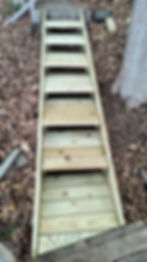
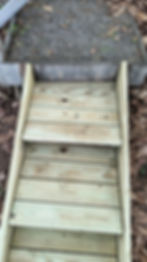
We just rebuilt a set of stairs on a walkway in Bayside down to the beach, and although the builder was obviously an excellent carpenter, good at compound angles and tight joints, the stairs only survived 16-18 years. Upon disassembly the reason was quite clear, no gaps anywhere. Cleats tight to stringers, treads tight to each other and the stringers, When water got into the joints, it stayed there due to capillary action and near total lack of airflow.

When rebuilding we used 1/4 inch spacer blocks between the cleats and stringers, and then chose a nice solid 3/16 inch gap between deck boards and stringers, all around. Just in case we also brushed on copper preservative to all contact points and cut areas.
Of course the same principle applies to PT lumber wherever it is used. Although rated as ground contact, that does not mean encased in earth. When used as a retaining wall, it is not enough to use filter fabric and then backfill with earth. Wherever wood is used, including PT, it needs to drain and dry. Even just a few inches of crushed drain rock directly against the wood before filter fabric and backfill could achieve this.

The goal isn't to keep wood perfectly dry, that's impossible outdoors. The goal is to allow wood to dry quickly after it gets wet.